OCPP vs OCPI: Different Roles
Distinguish charger-to-backend management from operator-to-provider roaming.
OCPP
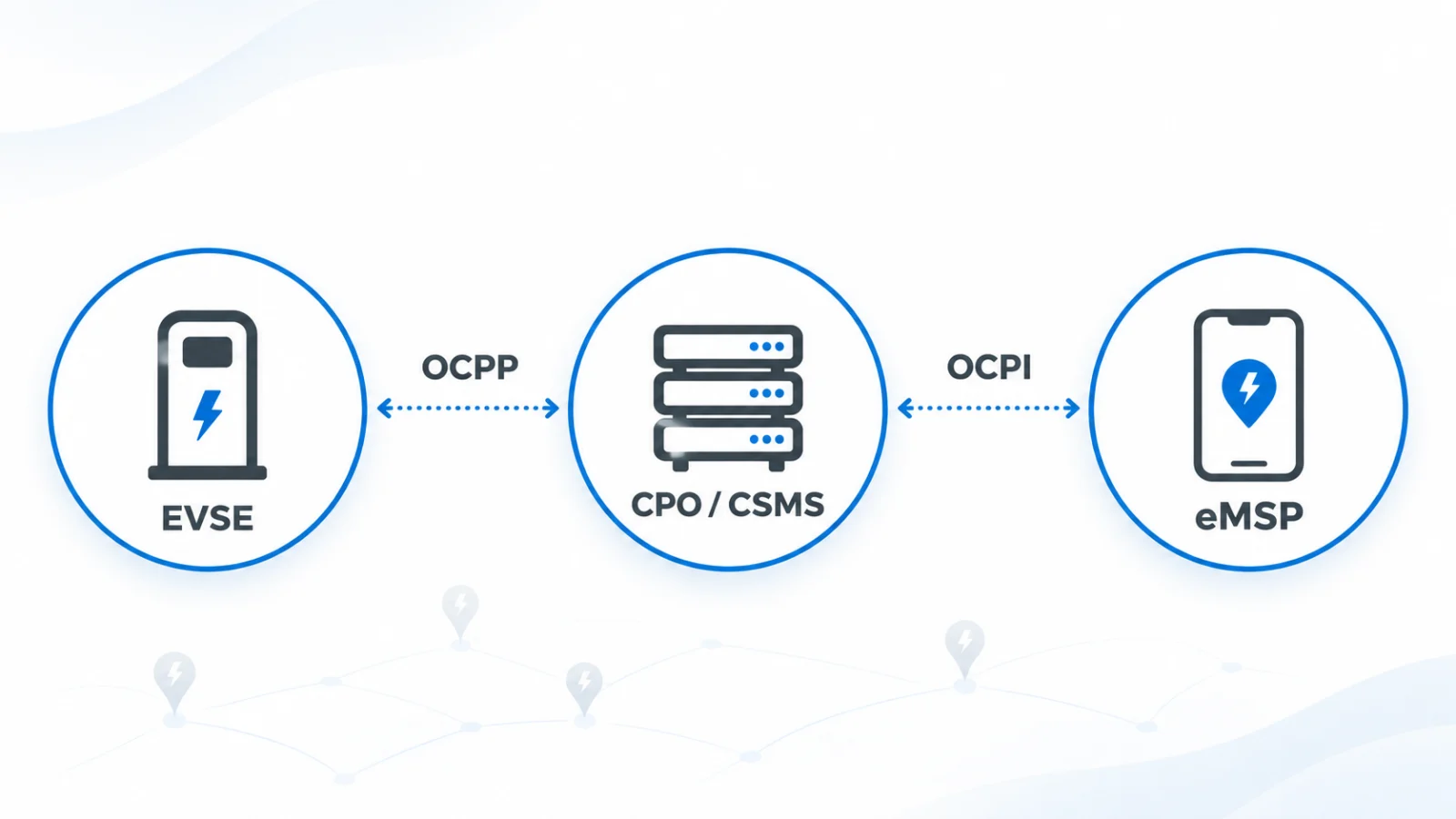
OCPP typically connects the physical charge point with its charging management system. It handles the charger’s status, remote management and session-control communication.
OCPI
OCPI focuses on data exchange and roaming between charge point operators (CPOs) and e-mobility service providers (eMSPs). It can convey location, tariff, authorization and session information between organizations.
Choosing the interface
A charger may support OCPP while the network operator relies on OCPI to make stations accessible through third-party mobility services. These protocols are complementary, not interchangeable.
Different communication layers
OCPP generally connects a charge point to its managing backend. OCPI exchanges information among operators, e-mobility service providers and sometimes roaming hubs. A purchase may require both, but they are implemented in different components of the service architecture.
Versions and commercial flows
The EVRoaming Foundation describes OCPI 2.3.0 as current in 2026. Ask which OCPI versions, modules, authorization flows, locations, tariffs, commands and charging-session records the operator platform supports. Do not assume a charging station directly implements every OCPI function.
Does OCPP compliance mean drivers can roam between charging networks?
No. Roaming usually depends on operator agreements and backend interfaces such as OCPI in addition to charge-point connectivity.
Primary references
Educational content, not installation or legal advice. Check current standards and local requirements.
Planning an EV charging project or sourcing enquiry?
CowinLink Limited works with manufacturing partners on EV charging sourcing, OEM/ODM and distribution enquiries. Share the target market, installation use case, preferred interface and estimated quantity; model specifications and compliance are checked for each project.
Discuss your project →